


Documentation

Troubleshooting
- Troubleshoot
- Known issues
- Troubleshoot
- Known issues
RANCHecking process take some time to complete depending on your project size. Starting from 1 minute minimum, it could stretch to an hour if you have hundred of GB to pack. Some parts of the process does not display any feedback in the Houdini Console but if you dive inside the RANCHecker Node you could see a bit more details like the number of remaining file to pack.
I’m on MAC how can I view the RANCHecker’s log?
Each log line from RANCHecker are sent to Houdini logger.
On Windows the terminal window is automatically opened at the bottom of the screen (except if there is some special parameters) and let you see some of the VUH archive creation steps (including the progression).
If you are using Mac, if you have a specific setup, or if you can’t find the console anymore, the log is available in Houdini’s “Log Viewer” panel. If this panel is not open in your Houdini session, you can open it by clicking on any + icon in the interface, then selecting “New Pane Tab Type” > “Log Viewer”.
RANCHecker stopped on “houdiniserver_begin upstream failures”
Affected versions: Houdini 19.5 to 20.5
Most of the time, houdiniserver_begin error “one or more error inputs node are not fully generated due to upstream failures” are related to the quantity of render engine and plugins you have install on Houdini.
Troubleshoot: Increase the Timeout parameter of RANCHecker. The value is in seconds

Please note that this RANCHecker’s parameter is only a highlight of an Houdini node parameter inside RANCHecker and does not represent the maximum time to complete whole process
My USDZ does not appears in my render
USDZ are Zipped USD file. RANCHecker could not access its parameters to fit the farm paths, so thoses files are not usable.
Troubleshoot: Unzip the USDZ and use the USD inside instead.
One of my file is not listed in the assets manager
Houdini always improve adding new feature or editing old one. Some time those features does not appear in RANCHecker assets manager. However you could always add the files manually inside the VUH.
Workaround: Use the scene path variable and 7zip manager.
- Put all the unlisted assets in your scene folder
- Replace the file path by a relative path starting with $HIP variable (ex: $HIP/Usd/myFile.usd)
- RANCHeck
- Open the VUH with 7Zip (right-click > Open with: 7zip manager)
- Drag and drop unlisted assets following the path you wrote at step 2(ex: drag and drop “Usd” folder at the root of the VUH)
For Reference node see additionnal workaround below.
I have upgraded RANCHecker, but it doesn’t work anymore in my scene
In the scene that already have a RANCHecker, you might experience some false positive error or break after updating RANCHecker. The reason for this is that there are still data from the node’s creation version that clash with those from the new version.
Troubleshoot: Delete the RANCHecker node from your scene and recreate it.
Known issues
“Unknow Setting” error on Karma projects (SOLVED with RANCHecker V2.6.1)
Affected versions: Houdini 20.0.724 and newer
Karma render Setting node has been modified since version 20.0.724. Unfortunately, the changes contain a programming bug. This issue affect our tool as we cannot query this node parameter to get essential information for your rendering like the Karma Engine, the resolution or the camera name
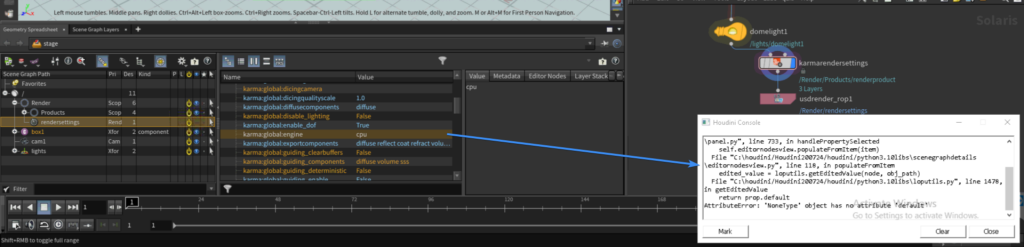
Workaround: Create a render setting node to replace the Karma render setting node.
Missing USD texture
Embebbed USD textures are gathered but mtlx paths are not replace yet due to attribute complexity when they are embebbed.
Workaround: Create texture node directly in the Houdini scene
USD file in Reference node not listed in Asset manager
Due to technical specificity “Reference” node type isn’t detected so it cannot be collected by RANCHecker for the moment. Then when trying to render the project failed on missing asset.
Workaround 1: Use “Sublayer” or “Asset Reference” node instead
Workaround 2: Create another node with a file path. Then link the nodes path with “Copy Parameter” from the new node path and “Paste Relative Reference” on the “Reference” node path.
In both workaround cases, be sure to check that the USD file are properly listed in Ranchecker’s asset manager before starting archive creation